Agency Logic
All the Old KnivesAgency Logic names a clandestine institution’s practical argument for bypassing law: suspected traitors cannot be let go, but cannot be prosecuted, so they are dealt with outside a courtroom. Henry Pelham invokes that reasoning as he prepares to have Celia Favreau killed, converting institutional self-preservation into a personal warrant. The scene’s reversal is exacting: after Henry has used the same logic to justify an execution, Celia tells him that his veal is poisoned and that his own side does not want a trial. The principle returns not as an abstraction but as the sentence that explains his fate.
The Logic of Extrajudicial Action
Henry’s formulation begins from a closed pair of options. In his account, the Agency cannot let traitors escape and cannot prosecute them; killing becomes the apparent solution left between impunity and a public trial. He calls this the inevitable conclusion of Agency Logic, making the action sound less like a choice than the completion of a rule. Yet the narration reveals that this inevitability is constructed: Henry has already decided Celia will not survive the night, and he wants her answer partly as a final justification in case someone at Langley connects him to what he has done.
The logic therefore serves two purposes at once. It authorizes violence against a suspected betrayer, and it supplies language with which the person ordering that violence can defend himself afterward. Henry does not seek a courtroom standard of proof. He has concluded that Celia found a crucial piece of evidence and deliberately concealed it: she saw a call in the records and did not bring it to Bill Compton. The call, Henry alleges, was to Ilyas Shishani and revealed information about Ahmed, destroying their only chance of getting people out alive. Henry acknowledges that this may not be courtroom evidence, but says that court is no longer the relevant measure. His certainty rests on an institutional world in which suspicion can be enough because the institution has chosen not to submit its judgments to trial.
Henry’s Personal Use of the Rule
The confrontation exposes how the institutional formula is entangled with Henry’s private history. He presses Celia to admit that she made the call, but her answer does not provide the confession he is seeking. He wants a final account from her before Treble’s departure leaves them alone, and he hopes the answer will make his own planned action defensible. The request is thus not simply investigative: Henry has already determined the outcome, and the desired admission would help him narrate that outcome as necessary.
When the recording phone is no longer capturing the exchange, Henry tells Celia that he did it for her. He explains that he acted to save her life, that his action killed many more people, and that he believed they would be together before she walked away. The confession connects the killing of Ahmed and the deaths aboard the plane to Henry’s attachment to Celia. It complicates, rather than cancels, the appeal to Agency Logic: the institution’s rationale supplies a framework for the act, but Henry’s own account discloses a personal motive bound up with love, betrayal, and the expectation of a shared future. He wants Celia’s answer to settle the moral account; instead, the explanation shows how little institutional language can contain the consequences of his choice.
The Reversal at the Table
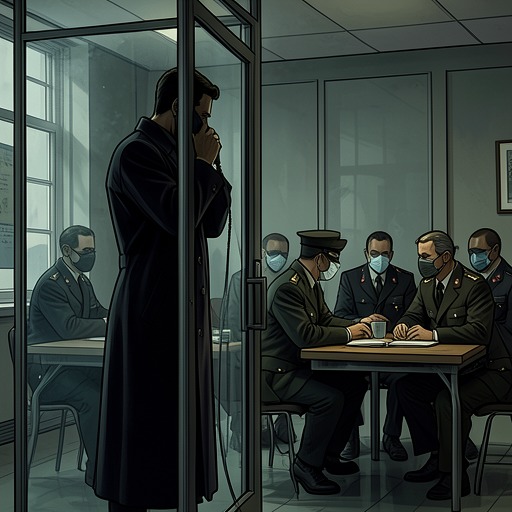
The principle changes direction when Celia tells Henry that his veal was poisoned and that they do not want a trial. Her words place him on the other side of the same arrangement: he is now the suspected traitor whom his own organization will not bring before a court. Henry’s features contract, and even shaking his head causes pain. Freddy closes the blinds and leaves the room; outside, Karl Stein estimates that five or ten minutes remain before they go in to clean up. The controlled procedure that Henry once treated as a solution has become his own death sentence, carried out without a hearing.
This parallel makes Agency Logic more than a cynical slogan. Its force lies in the way it turns the absence of lawful process into an accepted operational premise, then makes every participant vulnerable to that premise. Henry had wanted Celia to confirm his accusation so he could call her killing necessary. Celia’s disclosure makes the institution’s corresponding judgment of Henry audible, while offering no trial and no appeal. The closed circuit does not establish that the two cases are morally identical; it shows that the rule Henry relied on can be applied to him just as readily as he applied it to Celia.
Significance
The novel presents Agency Logic as a vocabulary of inevitability that disguises responsibility without erasing it. Henry says the decision is no longer really his, describing self-preservation as an evolutionary choice rather than a decision. But the surrounding details contradict the comfort of that formulation: he has made up his mind, seeks a useful justification, and chooses what to tell Celia. His language attempts to transform deliberate acts into the impersonal consequences of institutional survival.
The closing exchange gives that language a bitter symmetry. Henry once treated the impossibility of prosecution as a reason to kill; now the warning that there will be no trial marks the fate arranged for him. In both cases, the institution’s logic makes violence appear administratively settled before the person facing it can answer. Its apparent efficiency is also its moral trap: by replacing adjudication with self-protection, it offers no stable distinction between necessary action and convenient self-exoneration.